Posts

How to use a Compound Microscope?

Image
  Step 1- View Powers of 10 Video - Video and Interactive Powers of 10 Video Click here to access Power of 10 Website Click here to access Step 2 - Follow along with the Class and Reading in the Text Lesson #2 Reading - "Through the Compound Eye" and Microscope Pioneers. Click here to access P. 12-14 (First 3 Pages) Step 3 -Parts of a Compound Microscope - Video Step 4 - Virtual Microscope - Bio network Click here to access Click "Learn" to go over the structure of the microscope Click "Explore" to look at some different slides - There are plant, animal, and bacteria. You will need to use the coarse adjustment, different lenses, and light adjustment to see the slide.
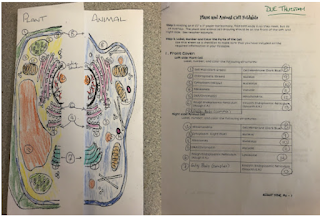
Comparing Plant and Animal Cells - Foldable

Image
 Animal and Plant Cell Foldable- Understanding differences and similarities between plant and animal cells Examples Essential Cell Organelles Cell wall Cell membrane Cytoplasm Nucleus Nuclear membrane Nucleolus Vacuoles Mitochondria Endoplasmic reticulum Ribosomes Golgi body Chloroplasts For each organelle you are responsible for: Where it is present in an animal cell, plant cell, or both Where it is found in the cell What the organelle looks like (structure) What the organelle does (function) HELPFUL LINKS: Cells Alive Link Biology 4 Kids-  use the links on the right-hand side. Sceincesaurus - Cells Here is another resource for you to use as you work to finish finding the structure and function for the different organelles of a cell: Science Explorer p 16-22-  Click here to access

Different Kinds of Cells and the Cell Theory

Image
  TEXT READING ON THE CELL THEORY and CELL OVERVIEW Cell Overview and Cell Theory Worksheet Click here to access Click here to access the Reading  -  Structure of Life   from Sciencesaurus. VIDEO LINKS TO CELLS: Link to Cell BrainPop Video Vocabulary: Prokaryotic Eukaryotic Cell Theory Information

Introduction to Cells- Structure and Function

Image
  Cell Unit- Standards NGSS Standards Assessed Develop and use a model to describe the function of a cell as a whole and ways parts of cells contribute to the function.  (MS-LS1-2)  Conduct an investigation to provide evidence that living things are made of cells; either one cell or many different numbers and types of cells.  (MS-LS1-1) Here is a collage of a set of living organisms. What do all these things share being living? Link to Sciencesaurus Reading on Structure/Function and Cell. You can use this to help you with the Structure/Function Foldable. Video on Things that are Alive-  Can you argue for or against ideas that Cookie has?  

Matching Classifications of flowers/plants

Maine Mushroom/ Fungi Database Click here to access  Click here to match the plants you found. Maine database of flowers. Maine Tree Identification Click here to access

Parts of an Experiment Study Guide - Vocbulary

Image
  Here is a Quizlet for Parts of an Experiment.   Click here to access More Study Guides - Vocabulary Systems vocabulary word wall game - hangman Parts of an experiment Word Wall game - Matching One more Wordwall  - Gameshow

Parts of an Experiment - Vocabulary, Reading and Video

Image
   We are investigating the scientific process as a system. This week, we will look at the structure and specific parts found in experiments.  Students will need to identify the different parts given in an experimental scenario.   Starting with the following article titled, "Life Saver," we read about scientists' methods of experimenting and solving problems.   Click to access the "Life Saver" Article Watch and take notes.   What are the parts of good science you saw the Mythbuster crew doing? Click here for the complete video Experimental Vocabulary: question hypothesis procedure variables: independent and dependent constant control conclusion observations Notes on Parts of an Experiment: Click here to access